The 2026 World Cup format changes how a tournament path should be read. There are 48 teams, 12 groups, eight best third-place qualifiers, and a Round of 32 before the familiar later knockout rounds begin.
That extra layer makes prediction work more interesting. A team can win its group and still land in a difficult bracket lane. A third-place team can survive the group stage and reshape someone else’s path. The WC26 Simulator is built to help you explore those possibilities before you lock picks in the WC26 Fan Zone.
It is not only a champion picker. It is a way to test tournament stories.
What the simulator lets you explore
The simulator runs complete tournament scenarios from the group stage through the final. After a batch of simulations, you can look at the tournament from several angles:
- Group-stage probability tables show how often each team finishes in each group position and qualifies.
- Round-by-round qualification probabilities show how often a team reaches the Round of 32, Round of 16, quarter-final, semi-final, final, or wins the tournament.
- Opponent-specific knockout path exploration shows which teams appear most often in a team’s path.
- Matchup frequencies and win rates help separate “we often meet this opponent” from “we usually beat this opponent.”
- Team-level strength exploration and manual adjustment let you test what happens if you think a squad is stronger or weaker than the default ratings.
- Score locking and custom result exploration let you fix known or hypothetical results and rerun the tournament around them.
That last point matters during the live tournament. As real results arrive, the simulator becomes a way to ask: what changed, who benefited, and which Fan Zone picks now look better or worse?
Example: Switzerland
Switzerland is a useful case study because it starts in Group B with Canada, Bosnia & Herzegovina, and Qatar. In the simulation example shown below, Switzerland looks strong in the group, but its full tournament outcome still depends heavily on bracket movement elsewhere.
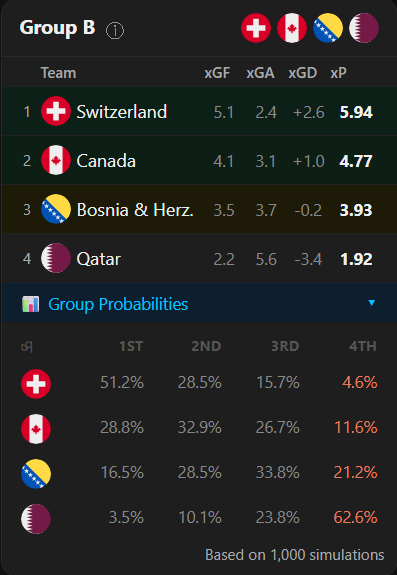
The group view is the first checkpoint. Instead of only asking whether Switzerland can advance, you can compare first-place, second-place, and third-place outcomes. That matters because the Round of 32 route can change depending on the exact group finish and which third-place teams qualify from other groups.
In this Group B example, Switzerland finishes 1st 51.2% of the time, 2nd 28.5%, 3rd 15.7%, and 4th 4.6%. That works out to 90.2% group qualification overall.
These screenshots show one representative 1,000-simulation run. Results can vary slightly when the simulator is run again.
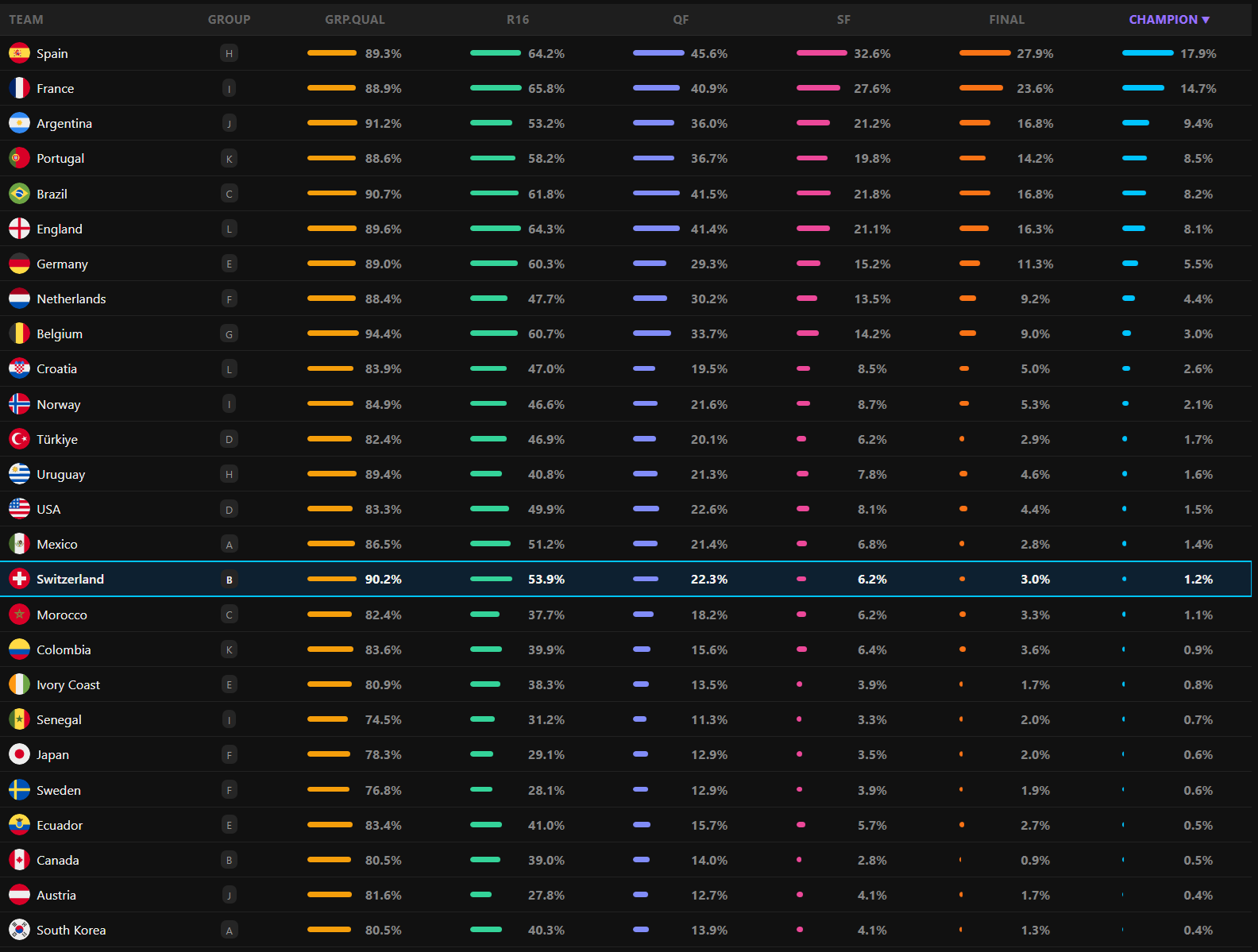
In this example batch, Switzerland’s path is roughly:
- Group qualification: 90.2%
- Reaches Round of 16: 53.9%
- Reaches quarter-final: 22.3%
- Reaches semi-final: 6.2%
- Reaches final: 3.0%
- Champion: 1.2%
Those numbers tell a compact story: Switzerland is in a strong position to get out of the group, but the path gets much harder once knockout opponents enter the picture.
Where the path gets harder
The most useful part is not just the final champion probability. It is seeing who appears in each round and how Switzerland performs against them.
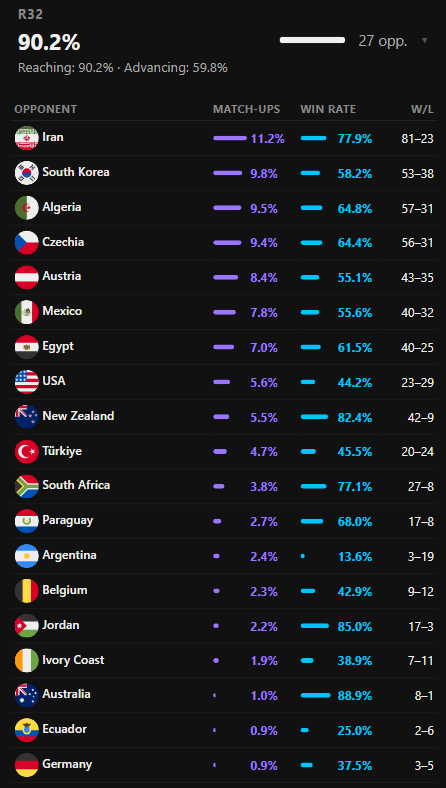
The Round of 32 opponent list helps you see whether Switzerland’s early knockout path is usually manageable or immediately dangerous. Frequency matters here: a difficult opponent that appears rarely is a different risk from a difficult opponent that appears often.
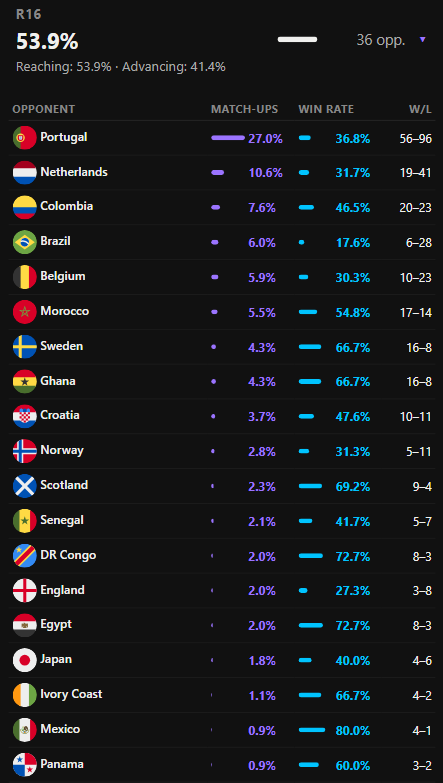
By the Round of 16, the bracket is more sensitive to results from other groups. This is where best third-place qualification can quietly matter. The exact set of advancing third-place teams affects bracket slot assignments, which can change the opponent pool.
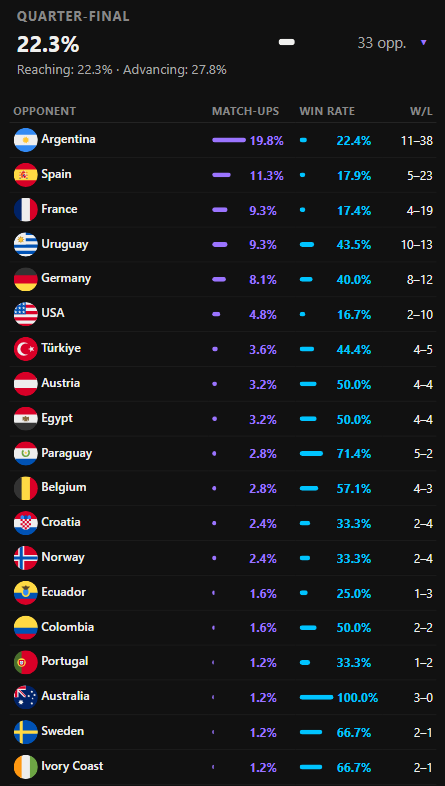
Quarter-final and later lists show where a plausible run starts becoming a long shot. If a team reaches this stage often enough, the simulator can still show whether it usually runs into one specific favorite or a wider mix of opponents.
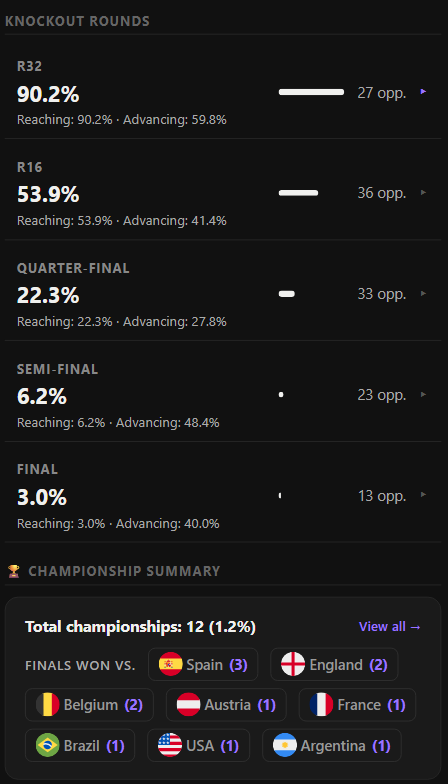
This is the value of path exploration: Switzerland’s group outlook can be strong while its title odds remain modest. The simulator helps you locate the turning points instead of treating the tournament as one flat probability.
Why this matters for Fan Zone
Fan Zone is not just picking a champion. Group order, third-place qualifiers, knockout paths, and Golden Boot selections all matter. A better prediction often comes from understanding how the bracket can open or close for a team, not just deciding which squad looks strongest on paper.
A practical workflow is:
- Start in the Tournament Hub to find the WC26 tools.
- Run scenarios in the WC26 Simulator.
- Check group tables, round probabilities, opponent lists, matchup frequencies, and win rates.
- Try manual team-strength adjustments if your read on a squad differs from the default model.
- Lock important results or hypothetical scores to see how the bracket changes.
- Use what you learn to make more deliberate Fan Zone picks.
The best use of the simulator is not to chase one perfect answer. It is to understand the paths well enough that your predictions have a reason behind them.
baplab’s Tournament Hub, Simulator, and Fan Zone are independent fan tools and are not affiliated with FIFA or any official competition.