The 2026 World Cup is not just bigger. It is a path problem.
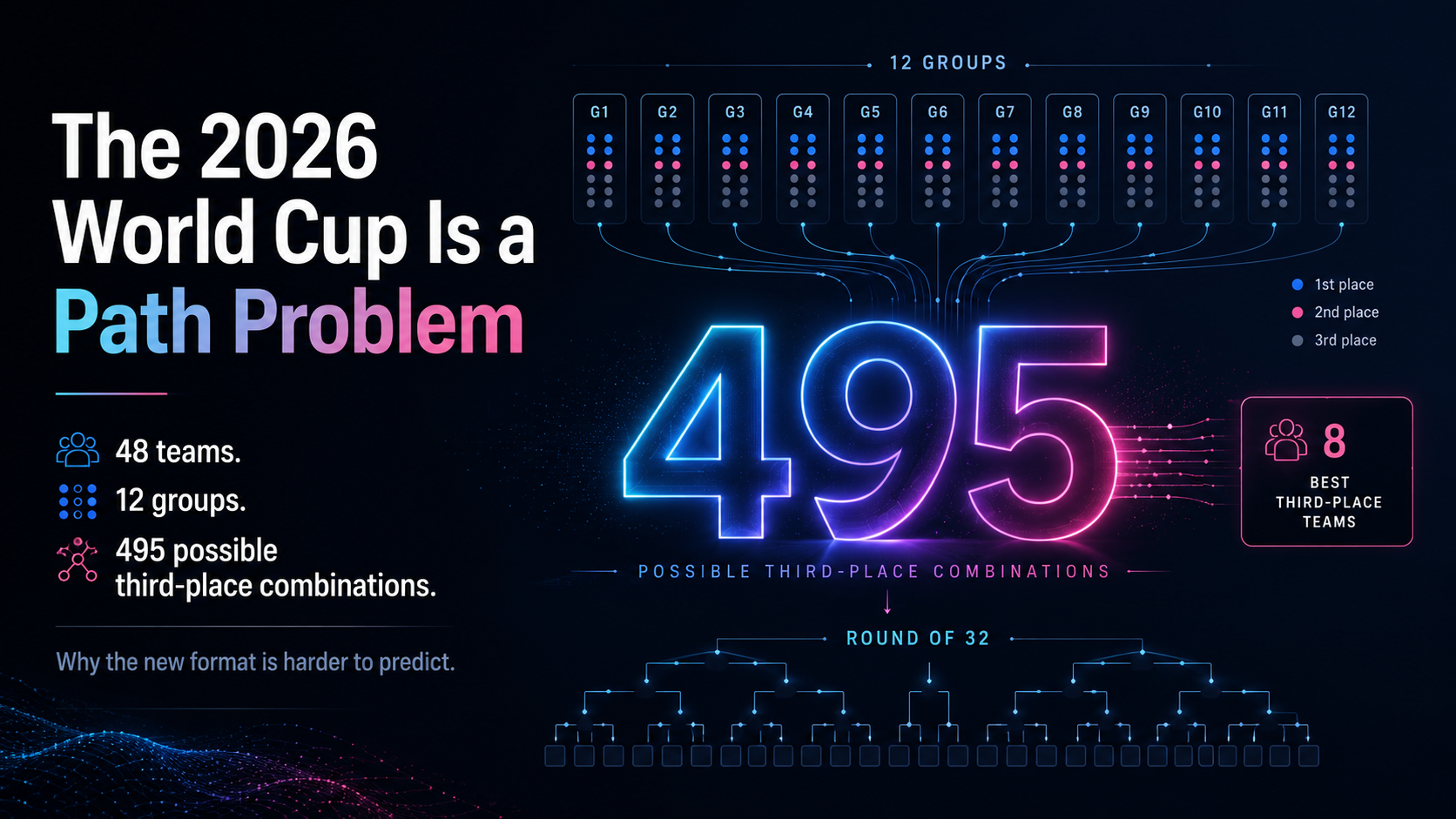
For almost thirty years, every fan carried the same map in their head: 32 teams, eight groups, top two advance, clean bracket. You could sketch your team’s road to the final on a napkin and mostly be right. The tournament was huge. The reasoning was small.
That map no longer works. And what replaced it is more interesting than “more teams, more games” makes it sound.
The world we got used to
From 1998 to 2022, the shape held still long enough to feel permanent. Win your group or finish second, and you walked into a Round of 16 whose layout was fixed before kickoff. Winners crossed with runners-up in a known pattern. To guess your path, you only had to watch your own group and the one next to it.
That’s the quiet property of the old format: your fate was local. A result on the far side of the bracket almost never changed who you’d play next.
In 2026, fate stops being local.
What actually changed
The field grows to 48 teams in 12 groups of four (the full structure lives on the Tournament Hub). Top two advance: that’s 24 teams. But 24 doesn’t fit a clean ladder, so the tournament adds a new opening knockout round, the Round of 32, and fills the last eight slots with the eight best third-placed teams.
That one rule is where a bigger tournament becomes a different kind of problem.
The 495 problem
Twelve groups produce twelve third-placed teams. Only eight survive.
The survivors are picked on record (points, goal difference, goals) across teams that never faced each other. And which groups those eight come from isn’t fixed. It shifts from scenario to scenario. How many different sets of eight can you draw from twelve? It’s a combination; we care which groups qualify, not the order:
C(12, 8) = 495
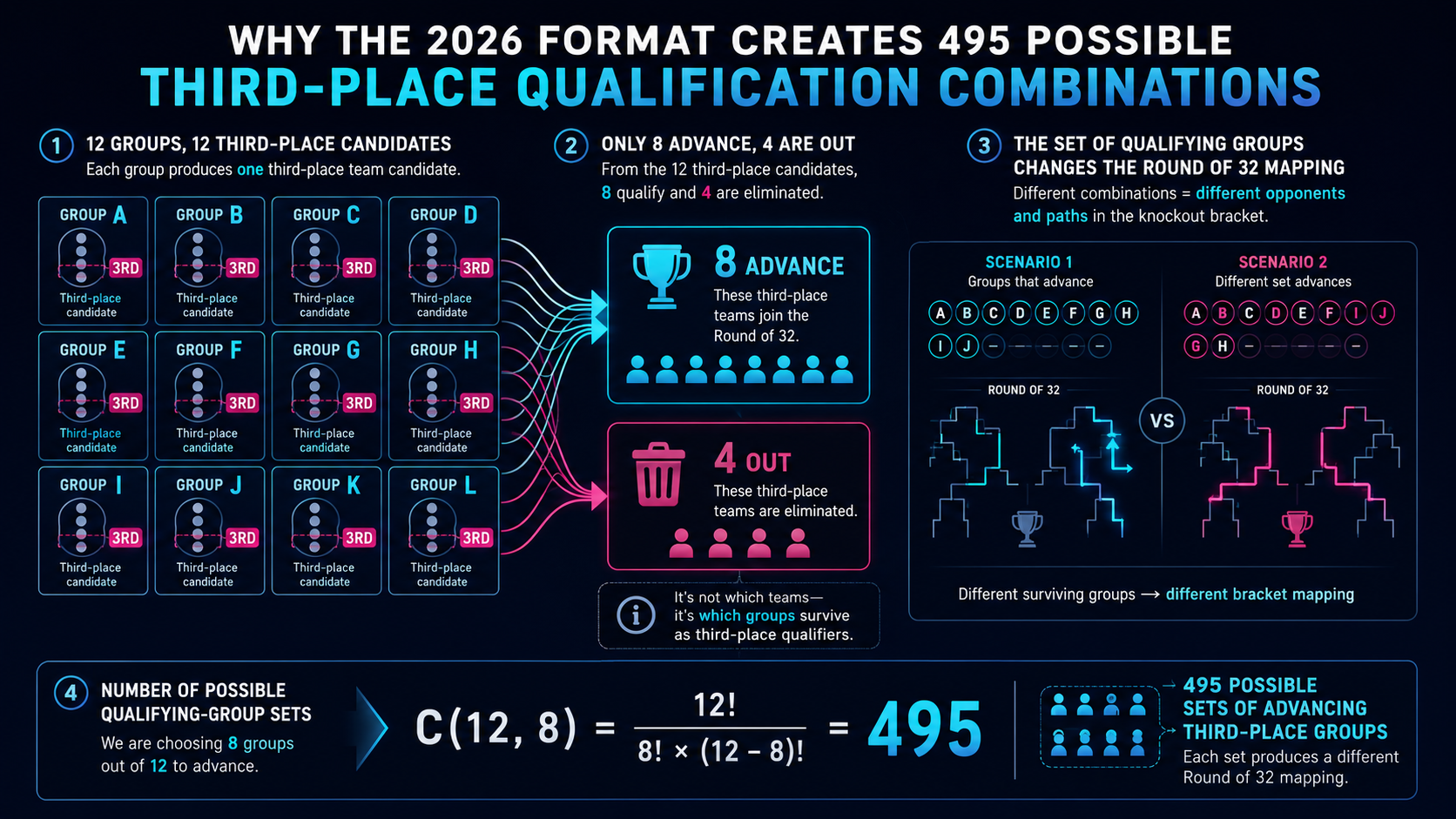
Four hundred and ninety-five possible sets of advancing third-place groups. Each one wires the Round of 32 differently, because the slot a third-place team drops into depends on the group it came from. Change the surviving set, and you change who plays whom, including for teams that already finished first and thought their next opponent was settled.
Why the napkin breaks
In the old format, winning your group bought a known, friendly path. In 2026 that guarantee gets thinner, and in a way that’s genuinely counterintuitive.
Your Round of 32 opponent isn’t decided by your group alone. It’s one of several possible third-place teams, and which one depends on results in groups you have no stake in and might not even be watching. You can top your group with a game to spare and still be funneled into the bracket’s ugliest lane. Not because you slipped. Because the math upstream of you landed wrong.
It cuts the other way too. A team scraping through in third (what used to feel like surviving on a technicality) can occasionally draw a softer road than a group winner somewhere else. Rare, never by design, but the format permits it.
So the honest answer to “who do we play next?” is usually a distribution, not a name.
Three questions the new format changes
Did winning the group actually help? Sometimes less than you’d think. A dominant group stage can still open into a brutal Round of 32 because of third-place teams routed in from elsewhere.
Can third place be lucky? Occasionally, yes. The same result that looks like barely surviving can map into a more forgiving lane than a group winner is facing.
“What are the odds they reach the quarters?” This is the question prediction-minded fans actually ask (the same instinct behind a bracket entry in the Fan Zone), and in 2026 the answer is driven by path as much as by quality. Two teams of near-identical strength can have clearly different chances of reaching the same round, purely because one tends to land in tougher lanes. Strength sets the baseline. The bracket sets the spread.
What we built
That’s the problem the WC26 Simulator exists to make legible. Not to call the tournament: to show you its structure.
It plays the full 48-team tournament thousands of times. Every run, it resolves all 12 group tables (tiebreakers included), picks the eight best third-placed teams, maps that exact surviving combination into the Round of 32 using the published bracket assignment rules for that scenario, and plays through to the final, logging every opponent and every exit along the way. (If you want the engine internals, How It Works walks through them.)
Do that enough times and a team’s path stops being a guess and becomes a measured shape. You don’t get one bracket. You get the range of brackets a team is likely to live inside.
What the numbers show you
Volume isn’t insight on its own, so the output is built around the path problem, not generic stats:
- Finish distribution: how often a team exits at each stage, from the group phase to the trophy. One chart, the whole spread of outcomes, no single forced prediction.
- Most Unpredictable Paths: the teams with the widest, least-settled range of journeys. These are the sides most hostage to the bracket math, and usually the most fun to track.
- Path by group finish: the same team, three different stories. Reaching the quarters looks very different depending on whether they win the group, finish second, or sneak through third. In this format, those are genuinely separate paths.
- Opponent breakdowns: who a team is actually likely to meet in each round, as probabilities instead of a single bracket guess.
- Estimate ranges: every percentage we show comes from a finite number of runs, so we attach the uncertainty using Wilson score intervals. A number with an honest range beats a number pretending to be exact.
That last one is the whole posture of the project. These are model outputs. They describe the structure of the tournament and the plausible paths through it. They don’t claim to know what happens.
The point
The jump to 48 teams gets sold as scale: more matches, more teams, more football. True, and it misses the bigger shift. The 2026 World Cup turned a tournament you could reason about locally into one where your path depends on the whole field at once, resolved 495 different ways.
We’re not here to pretend the future is known. We’re here to make the path visible.
Probabilities shown by the WC26 Simulator are model outputs from Monte Carlo simulation. They describe the range of plausible tournament paths, not certainties, and not betting advice.